
Can’t stop emerging. Forever the ‘emerging artist.’

Updated: Sep 27, 2025

This piece engages with Damien Davis’s recent article in Hyperallergic and challenges the structural limits placed on artists by the “emerging” category.
can’t stop emerging
forever
the emerging artist
forever artist
always emerging
timeless
eternal
never ending emergency
the emerging artist.
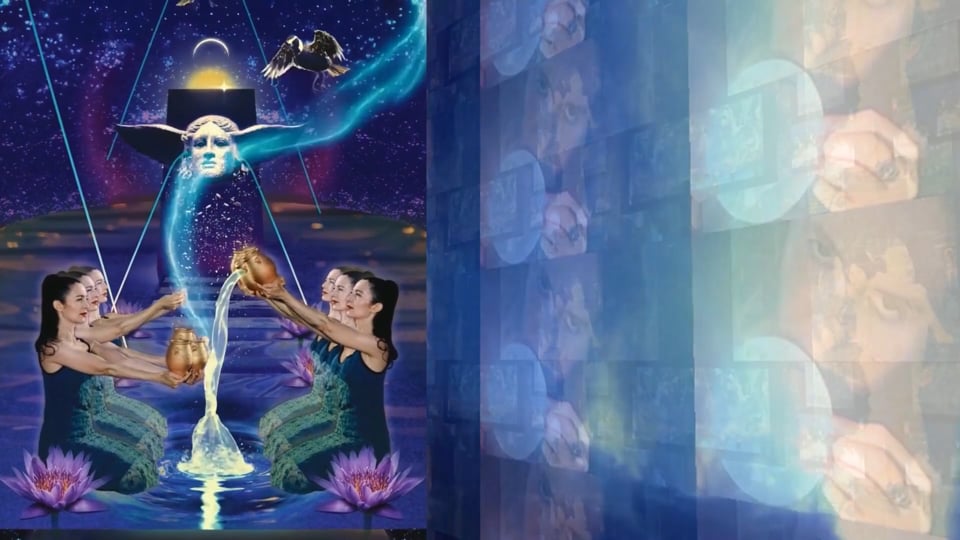
This piece is screen choreography derived from stills of a performance for the camera, re-choreographed through an AI model. It critiques the outdated notion of the “emerging artist,” exposing how the term operates not only as a label but as an obstacle within the art world.
Inspired by Damien Davis’s article “When Artists Are Too Old to Be ‘Emerging’” (Hyperallergic, September 20, 2025), the performance — first created for the still camera in my early (emerging) twenties — is re-emerging as a state of timeless becoming.
The couple represents the Jungian anima and animus — the two complementary aspects of the creative artist’s psyche and body. They reject and resist the imposed category that obstructs the organic flow and emergence of artistic trajectories.
#EmergingArtist #AlwaysEmerging #ArtWorldCritique #ScreenChoreography #AIChoreography #ArtistsManifestos #TimelessBecoming #LiminalTime #PerformanceArt #VideoArt #Hyperallergic #DamienDavis
Have you ever stopped emerging?
Creativity is like a fountain, always emerging like clear, pristine water from the depths of the Earth, from the roots of your psyche and soul. This flow has its own timing; it is almost beyond the ticking clock, not restricted to day or night, your location, number of followers on social media, and especially your age. This creative flow belongs to the individual self and yet it is emerging from a collective resource like a fountain that emerges from the ancient Earth. Perhaps that is why the Earth was called Mother of the Imagination. One day, deep in her belly, she gave birth to what we now call ART. The first art world and art gallery emerged in the caves in her belly. No wonder art and earth share the same etymology.

Too old to be emerging
I therefore sensed an intellectual relief when I recently found the article ‘When Artists Are Too Old to Be “Emerging”’ by Damien Davis (Hyperallergic, September 20, 2025). The article critiques the imposed category that obstructs the organic flow and emergence of artistic trajectories, which often occurs in a non-linear and liminal time.
In the ‘real’ art world — not the imaginal art world where creativity emerges like a fountain from the depths — emerging artists are restricted by an age limit. Over thirty years old, an artist is soon transferred to the ‘mid-career’ category, after which, if they ‘didn’t make it’ in art-world terms, they are doomed, excluded from the art world forever.
However, as Damien Davis eloquently writes:
‘But artists have always modeled other ways of living in time. We change mediums, circle back, recommit. We emerge at 25, at 40, at 70. We resist straight lines. If the art world is serious about equity (as it often claims to be), it has to learn from that. It has to stop equating emergence with youth and start building structures that reflect the multiplicity of artistic timelines.’

A life in perpetual emergence
I started young and found my language as an artist in the medium of multimedia performance at the age of 21. I was therefore considered ‘emerging,’ but my emergence was obstructed by circumstances and developed as a perpetual flow over the years. Like many women artists of my generation, I moved from country to country and from medium to medium — from the then-new technology to the next emerging technology, from VHS to DVD, and from no resolution to HD and 4K+ mp4 files. From video cameras — once too expensive and impossible to obtain — to cameraless filmmaking. Each new technology offered more tools for innovation.
“Film will only become an art when its materials are as inexpensive as pencil and paper.” — Jean Cocteau
The artist, poet, and filmmaker Jean Cocteau — whose work I have always adored — stated that film was not yet a true art form due to the high cost of its production. He rightly affirmed that art making, in the profound sense of the term, should be accessible and require minimal resources to create, much like writing or drawing.
Hence, as soon as digital technology became widely accessible, I was able to return to my unrealised concepts and scripts — hidden in a box and gathering dust under a forgotten bed — and wake them up to re-start emerging.

The artist’s eternal timeline
Jean Cocteau created his masterpiece Orpheus in 1950 and returned to it a decade later with his final meditation, The Testament of Orpheus, completed in 1960 when he was 70 years old. Even today, it is difficult to compare these films to any other works of filmic art; they stand as singular monoliths of human imaginal creativity — acts of perpetual emergence.
The hero of Orpheus is a poet, whose psyche’s counterpart — his anima — appears as a mysterious woman named Death. Together they inhabit an eternal realm, a liminal zone between life and death, where fears are confronted and the quest for artistic immortality unfolds. The poet exists beyond age and terrestrial time; his Anima — his Death — rescues him from the existential horrors and despair that shadowed the world during the Second World War.
Cocteau’s poet faces reality differently. He escapes oppression and the machinery of war by stepping outside the confines of social norms, dictatorships, and linear time itself. In doing so, he models an artist’s path: to emerge continually, free from the boundaries that society, politics, and age attempt to impose. Orpheus stands as a declaration of the power of art, imagination, and creative liberation — an art that transcends age and history and remains forever emerging.
Can artistic emergence have an expiry date?
Who Decides When an Artist Stops Emerging?

The image is based on the clock that used to hang at the Theosophical Society building in London. Photo and montage by Lila Moore. |




Comments